


Repair or replace? Start with the fleet's real need
The cheapest quoted action may not solve the airline's requirement, and reuse is not automatically a quantified carbon saving. Build a comparison that makes readiness, technical admissibility, cost and resource claims visible as different questions.
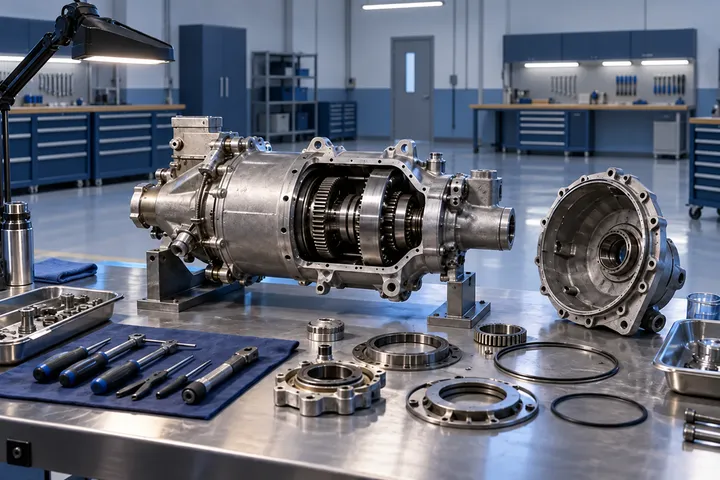
Illustrative image—not evidence of a real case or verified capability.
Define what the airline needs to recover
A repair decision is easier to discuss when the operational requirement is explicit. Does the airline need a compatible unit for a near-term recovery, a replenishment for base stock or a longer-term replacement strategy? Those needs can produce different choices even for the same removed component. Separate the immediate aircraft event from the later asset decision: an exchange may address one while repair of the removed unit addresses another. Define the intended period, location and configuration, then let the responsible technical function establish which options are admissible for consideration. Commercial urgency cannot make an unsuitable alternative suitable or replace the authority required for maintenance and installation decisions.
Use a common cost boundary
Place quotations on the same basis before ranking them. Include evaluation charges, repair material, replacement or exchange price, Core exposure where applicable, transport, handling and agreed warranty conditions. Keep uncertain amounts separate from confirmed charges. If downtime is valued, state whose estimate is used, which period it covers and which operational alternatives were considered; do not treat a generic daily aircraft cost as a measured loss for this event. Consider the working capital tied up in the chosen asset and the actual scope restored by the action. A comparison becomes more useful when another person can reproduce the assumptions than when it displays a more elaborate total.
Account for the uncertainty that matters
A repair estimate may depend on findings not yet available; a replacement offer may depend on document acceptance or a transport window. Record those dependencies rather than presenting every lead time as equally certain. Consider how a delay could affect the next aircraft rotation, a reserve unit or a planned maintenance event. EUROCONTROL's discussion of schedule buffers shows that resilience involves a trade-off with resource utilisation; the European example does not quantify an Iranian airline's situation. Here it prompts a local question: which uncertainty can the actual operation absorb, and which requires another supported option? A procurement dashboard can organise the options while operational decisions stay with the airline's authorised people.
Keep the environmental comparison separate
Repair and reuse can retain value in existing material, but their environmental outcome depends on the comparison being made. ICAO's circular-economy material and Airbus' resources discussion describe lifecycle thinking and ways to retain or recover resources. They do not provide a universal emissions credit for every repaired component. If you want to quantify an impact, define the alternative, lifecycle boundary, relevant transport and processing inputs, data sources and uncertainty. A purchase-price difference is not an emissions factor. Where that evidence is unavailable, report the observable action, such as a unit repaired for continued use, and state that environmental benefit has not been quantified rather than inventing a percentage.
Record the decision and revisit the outcome
Keep a short decision record showing the requirement, admissible options, chosen basis, unresolved risks and responsible approvals. After completion, compare the actual cost and timing with the assumptions, without rewriting the original estimate to match the outcome. Did a finding change the repair scope? Was the replacement route constrained by evidence or transport? Use those observations to improve the next comparison, not to claim that one option is always best. A modest repair-versus-replace review can strengthen fleet support and responsible resource use together. It remains an organisational decision supported by evidence, not a software instruction to trade safety, disregard controlled limits or issue an environmental certificate.
Sources & scope
This is editorial educational analysis. Licensed manuals are not reproduced; Iranian applicability and independent technical approval are not established. Actual operations require current controlled sources and authorized decisions.
Continue with the Library tools
Related reading
On this page
Test the idea, not just your memory
Short learning scenarios with explained answers—not a qualification test, training certificate or operational decision.